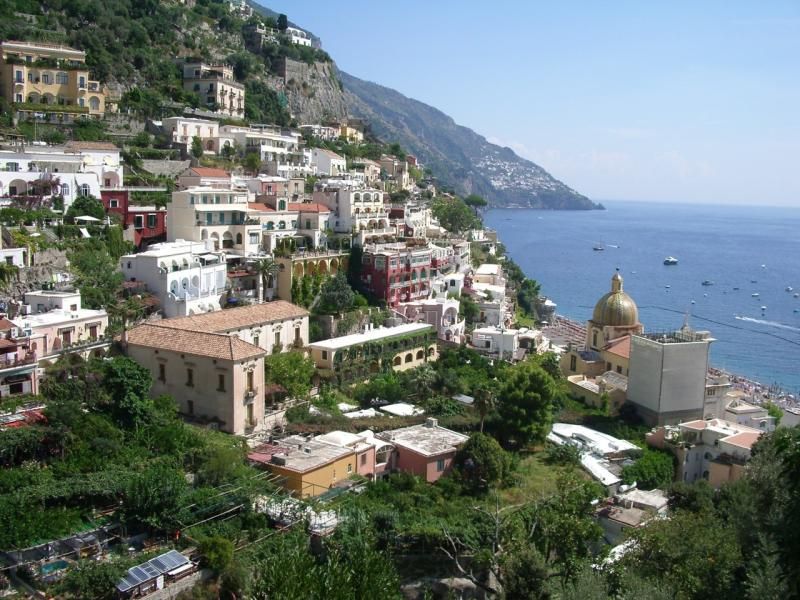
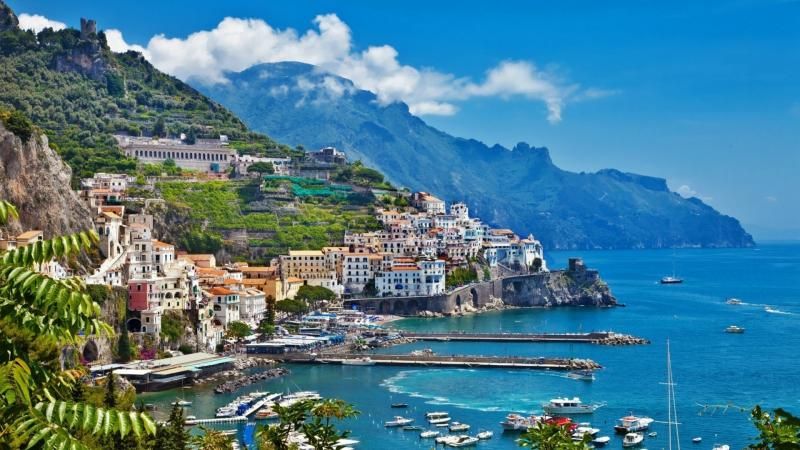
In Forza Motorsport 3 and 4, the driving game includes courses on the Amalfi coast in Italy, in Positano which is a World Heritage Site visited by thousands of tourists every month year round. Positano is one of those really amazing places with no parking.
Walk everywhere because its a medieval city. Its very steep. There are paved stone staircases lined with hand-laid rock walls. Same with the few roads through it. Most are also paved in cobblestones. Driving on cobblestones is slippery and jiggly. The seas are usually calm because its the Mediterranean. You can build a jetty and harbors are simplicity itself. There's no serious currents. Its just pretty. A great place for boating, but no actual beach as you can see. Beaches require sand, which comes from sandstone eroding inland or being carried there by currents or rivers. If there's no rivers, there's no sand.
If you look at that sea, imagine it is rough with 10 foot high waves snapping ashore, throwing spray in the air 40 feet high and then blow down into the distance 200 feet in the stiff breeze that rarely stops. That's kinda what the Pacific Coast looks like when the fog burns off, which doesn't happen every day. Somedays it stays foggy and chilly enough to cause hypothermia. Windbreaker jackets exist to deal with that weather. The winds on the Pacific Coast affect the building design, since it is rarely sunny enough to want to hide from it. You make the most of the sun you get, and you shelter your plants and their soil because the wind is so strong it rips their leaves off, twists their branches, and tears away their soil. Its a challenge for an architect since the wind driven rain wets the blown salt spray and causes serious rust of anything steel there, and even corrodes aluminum. The wind blows water up and under clay tile roofs like you see in the pictures, so those are useless there. The sand that blows around chips paint and window glass. There's also landslides, earthquakes, twisty roads and rockslides, and sometimes flashfloods roll down and tear out the hairpin turn of Highway 1. The upshot being there's a lot of maintenance and repairs required if you choose to live near the Pacific Ocean. Contrast with the above calm of the sea in the Amalfi harbor. So pretty. Love to live there, right? But the fish is better in the Pacific. Fish like cold water. It holds more nutrients. The boats in Bodega Bay, which is way more spread out than Positano and Amalfi, are strictly working fishing boats, with a few running whale watching or salmon fishing for the tourists. The bay itself goes shallow enough they raise oysters there. The channel gets dredged every 5-10 years, depending on money available for it. If the salmon come back, there will be money. That's how things are. If the homes were closer together, they'd emulate more of what charms Positano offers. Ultra-dense housing in classic vintage stone makes for a very walkable community. As it is now, Bodega Bay more strongly resembles the set of the 1980's horror flick "The Fog!" by Stephen King. So how can a foggy, windy, smelly place that's often cold become more cute, more walkable, more charming, enough to keep pulling tourists even after most of our oil is so expensive and exported that the drive itself is half the expense? I think about things like that.
The upshot of that expensive drive, and a big part of the draw of the coast itself, beyond views and really delicious locally caught fish, is the drive is long, twisty, scenic, and fantastic in a touring car or sports car, depending on if you're taking your wife or your girlfriend. Because even if you love your girlfriend, your wife will hate her. So strict separation is required. Ahem. That was a joke.
There is a nice loop available too, actually SEVERAL loops available. Marin County and San Francisco folks used to come up through Mill Valley and climb over Mount Tamalpais, which is the road featured in the chase scene of Basic Instinct, which does NOT do those curves justice, then follow Hwy 1 up through Point Reyes Station, along Tamales Bay, past Dillon Beach, and into Sonoma County and up to Bodega Bay through the various twists and turns and beaches, then further up to Jenner and then land on River Road towards Guerneville, following the Russian River through the big Redwood and back to the Wine Country. You end up nearby either Santa Rosa or Healdsburg, depending on a left or right turn, or you can cross over the Highway, go another 10 miles and be in Napa County at the head of Napa Valley in Calistoga, at the north end of the Valley. Napa is at the South end. Between are the best wineries on Earth. That makes a nice place to spend the night and the next day can be wine tasting brunches and a slow meander back home with a properly tame and satisfied woman beside you, no longer fretful and obnoxious. That's what a proper vacation up the coast should do for you. So, if Bodega Bay looked a bit more like Positano, creeping up the hillside, crammed together with walkways, cheerful people waving as they meandered by, would that be worth a visit? I think so. Now repeat with Fort Bragg, Mendocino, Eureka, and those other little seaside towns up Highway 1. And be sure to offer a nice charging lot for all the Tesla's, and B&Bs for the couples to recharge themselves within. So long as California remains as a center for tourism and agriculture, it must continue to focus on those two things so it can make money and justify the costs of its maintenance and visitors.
Something I really respect about Italy is the entire peninsula is full of volcanoes and gets earthquakes, yet they build out of stone anyway. I appreciate that sort of dedicated "F-U, nature" of Italians. Also, the understand the important things of life, namely good food, wine, and women all exist to be enjoyed, not hoarded. Where I grew up we had both Italian and Portugeuse immigrants, living working, intermarrying. One of my better friends had parents from both camps, and her dad baked really excellent French bread. The bakery has since gone under, but it was the kind you wrote sonnets about and served with fresh butter or sharp cheeses. Good stuff.
You really shouldn't build with stone in Earthquake country, yet there are lots of buildings that survive the quakes for one reason or another. As I understand it, the bullet scarred walls from the Allied invasion, retaking Italy from the fascists in WW2, are still there, sometimes left as is. There's a distinctive pride in that. I wonder if we should build that seriously here? Out of stone rather than steel and concrete. Put some labor and pride into our homes and workplaces, and expect to use them for centuries rather than tear them down like tents in 10-15 years like we've been doing with most commercial real estate. There were a lovely group of craftsman bungalows along the nasty green lake in South Reno, all carefully maintained. Someone bought them, tore them down, and will replace them with new duplex condos because its easier to build new than retrofit. They can get more profits. This is a shame. The new condos weren't much for character. And the lake still stinks.
Something I find a bit confusing, is America has these enormous cities, even my own home town has gotten huge, but there's few jobs beyond the obvious retail and repair and basic medical. For actual industry? Not so much. My home town was pretty odd because it had a restaurant for every 40 people, the highest number in the world. Can you imagine? Working in the food industry was something people make full careers from there. Of course, being allergic to raw shrimp, the single most popular restaurant meat, means I can't do that myself. I get nasty hives. Can't handle crab either.
Bodega Bay, which means Bay Bay, which is NOT the same place as Bodega, which is in a valley, on Highway 12 but not actually in view of the ocean just close to it, and was the site of the Hitchcock movie The Birds.
And yes, that schoolhouse is still there.
The big upside of old, pre-car, architecture is it remains classical and useful after cars are gone, and when you parked in newer carriage houses converted into a garage in another building. The house itself is a house. The various Victorians and bungalows in the old towns across California are the ones that hold their value. Not the newer and poorly made ranch houses, which eventually turn out to have black mold and termites. The old houses might have plaster lath and ancient electrical, but most have been updated decades ago, at prior owner's expense. You may want to replace the avocado green tile and the burnt umber or ochre shag carpet and maybe fill in the conversation pit that was so stylish in the 1970s but is just a tripping hazard that reeks of patchouli oil today.
A modern or old bungalow, the typical Craftsman Bungalow built by hand, over time, by a young man who ordered the plans via a Sears-Roebuck catalog and did all the construction on weekends with hand tools for the immense sum of several thousand dollars in materials, and land that must have cost a hundred, easy. The angled square pillars are usually plywood and hollow with a normal 4x4 post inside to hold up the porch roof. The various details are all hand made, bit by bit, adding value to the home after its finished and liveable. All are basically night or weekend projects. I think even the window frames were handmade, with the glass ordered in sheets. In a Craftsman, the builder does everything. Ironically, the Art Deco material, glass blocks, are very good insulation, being R-30, since they are a vacuum inside. Walls of glass blocks provide excellent light, yet allow privacy. Same with stained glass and obscured glass (rippley kind) which lets in light yet retains privacy. On a very small lot, this is a good thing. Using your spaces to provide good light to a home is so important. I've lived in too many dark places to like them very much. I want natural light.
I think it is worth noting that there are many very beautiful Bungalows in both Oakland and LA, but not all of them are maintained due to being rentals with Section 8 criminal gang members living inside. This is a shame. Once water prices rise without subsidies to cushion them, many of these homes will end up abandoned as their residents flee for more affordable cities. Perhaps they'll move to Detroit, where you can buy a distressed home downtown for $500. You might get shot or stabbed there, but you can own it. And if enough people move from Oakland and LA to Detroit, maybe this crucial difference will enable them to make a serious change, and restore the city to greatness. It really is a fantastic location, geographically. They just need to make a living doing something other than just building cars nobody can afford anymore.
Here in California, I look at the tiny Sacramento Valley towns, the farm towns, with their abandoned railroad passenger train stations empty, businesses shuttered on actual Main Streets, beautiful bungalows needing attention, and ground water only feet down as the river flows by, and I think: this place has potential. It needs jobs. It needs industry. I hope that Jefferson brings them in, like Reno has. Allow Lacquer and you'll get furniture makers again. Deny carbon taxes and you'll get welding shops and machineshops moving in from the Bay Area, where the lunatic Greens in Berkeley have nearly killed them off, the spiteful pricks. There's more manufacturing in Woodland and Colusa and Yuba City than there is the Bay Area. And there could be a lot more. These towns would welcome a Toyota Factory, building trucks and small cars. They could sell them locally too. If there were a Subaru Forester Plant in Roseville or Loomis they'd sell all they made in the Sacramento metropolitan district and Sierra Foothills, easy. Hear that Subaru? Jeep is rare up here. Lots of Subarus everywhere. I would totally buy a WRX STI if I had the money. They're great on these roads, and we get enough snow lingering for it to make sense.
I really think there's a future in cute grid-pattern valley towns, from 100 years ago. They've got local water, which is so important, cheap. What they need is jobs. Once the price of water goes up in the Bay Area, following either the split or the collapse of the pumping subsidy, most of the big industries will bail out of the East and South Bay area. Poof! That price will also cause a housing bubble collapse, which is long overdue anyway. Most homes in the Bay Area are nearly worthless ranch houses with termites singing Kumbayah and holding hands, which is all that's keeping them upright. Don't buy a home built on an orchard. The termites eat the roots of the trees cut down and bulldozed over to build the tract homes. When they run out of roots to eat, the tunnels upwards and eat your home. This is WELL KNOWN from tract houses in Orange County. And termite eaten wood must be replaced with treated wood, which they won't eat, but if they get up into the walls and attic it is too late. You're better off with arson at that point. Considering most Bay Area tract homes are $2500/mo to rent, and $3800/mo. for a mortgage, and both parents must work to cover that outlandish cost because your average home for a middle class working couple is $600K, you can buy in Sacramento Valley for around $200K or considerably less in the really small northern towns. Better house, same size, with grid streets instead of cul-de-sacs. Riskier for the children who play in traffic, but better for public transit and bicycles. And children playing in traffic are incipient Darwin Awards, after all. Duh!
Small towns are cheaper to run than big cities. They don't require as many services, or employees running those services, because they are small and residents have reasonable expectations, rather than overt racism driving their demands for "more!" like you see in Oakland and South Sacramento and North Highlands, which are high crime areas filled with a certain minority that claims it can't be racist "just because." Uh-huh. Nice to know who to avoid living near. A shame since 35 years ago, Oakland had some of the best metal workers in the world. They're all retired and gone now. A pity.
The other big thing which makes small towns liveable is water supply, which can be managed via reservoirs and pumping stations and tanks and wells and canals and diversions. The West side of the north Sacramento Valley is in rain shadow. Rain shadow, aka Banana Belt, is the chemical reaction to water and heat, wherein the change from vapor to liquid releases heat, which when the pressure changes as it descends, is different dry than wet. This is called Adiabatic Heating, and you find it is the cause for the warm winters in Palm Springs, and the relatively lack of snow in Reno and Ashland, since the air descending from Pacific weather systems becomes too warm for much precipitation. Very important. This lack of rainfall behind, east of, the Coast Range mountains of Northern California, soon to be Jefferson state, means that its dry grassland with only creeks draining out of those hills for water supply. These creeks are where you find the towns, which are the only places with drinking water for people to live there. A plan was proposed a few decades ago to build a big reservoir on the wet side of the hills, then using an aqueduct and tunnels through the mountains, carry the water through, irrigate, and gain a huge farmland area, which would be a boon to both real estate and farm income, which is America's most important export. We feed the world. And if we stop, the world loses 2 billion people rather quickly. Remember that, world. You need us to stay alive. Famine causes war and disease outbreak. I would not be the LEAST surprised to learn that ISIL accidentally causes a massive plague outbreak of that middle eastern severe respiratory (MERS) virus I've read about.
I'd like for America to ignore the Middle East entirely, and let them kill each other. We can focus on farming and manufacturing and living in beautiful homes and maybe see about constructing things out of stone. The coat of Amalfi, which is a world heritage site, could be duplicated on the northern California coastline, even with the earthquakes. From Tiburon and around the Marin Headlands, the north end of the Golden Gate bridge, up the coast through Point Reyes Station and Bodega Bay, up to Jenner and Fort Ross, Mendocino, Fort Brag and Eureka and Crescent City. Coastal tourists stop in every town on the Oregon coast, but they go inland rather than cross into California because its ugly and sad here. And that needs to be fixed. If it was touristy, tourists would come. Hopefully, Jefferson State redevelopment experts will push investment there, once the crucial infrastructure is dealt with, and the money is rolling in. If all we did was mimic Reno, we'd still be better than Lower California. And that's so key.
California, and the West in general suffer from various disasters, and has the potential for others which happen more rarely. These disasters cost a lot of money when they happen and some are inevitable consequences of physics, some of maintenance, some are very random and completely beyond our control.
The best way to survive a local disaster is be somewhere else. Don't stand in the way of the erupting volcano, or below the dam that's breaking. So long as you CAN leave. But that's at the personal level. The govt has to deal with the disaster, though sometimes the right answer is to leave the ruin behind as a warning. Not all the ghost towns in the West are abandoned mines.
Did you know that all coastal nations in the Pacific experience Tsunamis? Any Pacific ocean quake, like the one in Thailand, is capable of generating a huge tsunami which will affect parts of the coast. Some more than others. In 1700, a major quake off the Oregon coast destroyed entire villages in Japan, which was documented by monks there, complete with woodblock prints and paintings. The wave also went 30 miles inland, knocking down entire coastal forests. In contrast, most of the Central California Coast is steep cliffs with few harbors so a tsunami is pointless and does nothing to most of it. The long slope in Crescent City north to Canada, however, Pismo and Long Beach, are both able to get some bad consequences from a tsunami. Ironically, as best as I understand the hydraulics involved, the Bay Area is largely immune to tsunami due to the narrow and deep entrance of the harbor (the Golden Gate is the gap, which the bridge is named after) and the length of the waves limits how much energy can get into the harbor. While you'd think they'd transfer energy to every shoreline and flood San Jose and go upriver and flood Sacramento... not so much. But the coasts can take a beating and there are now signs warning evacuation routes to escape incoming events, if you're lucky enough to get sufficient time to know what's coming and the alarms to sound. As we're due for a major event there, in the upper 9.6 richter scale (where the energies get really huge and the damage total) sort of like what Chile and Ecuador get, when that happens everything is gone, lots of people die, and the survivors will suffer. As it is now? There's nothing being done and the California coast is helplessly unprepared. Presumably Jefferson will do a better job.
Planning for that sort of disaster and rotating preps and assigning budget will be important. We usually do these in Veterans centers, high school gyms, any large central building where supplies can be stored and wounded treated by emergency room doctors. And its really that serious when trouble comes. Wildfires can kill from smoke inhalation too.
We need to deal with forest fires every summer and fall, and landslides and flooding follows fires. Our rainfall is seasonal, so our flooding is seasonal. We have off-times for preparation and maintenance, but LA took all the money for themselves, because they have the votes. Democracy is oppression, two wolves and a lamb deciding what to eat for lunch. This is wrong, but as long as they have the votes, we get flooding and disaster. I worry about disasters because rebuilding after them doesn't always happen. If the situation is bad enough, and the money isn't there, you end up abandoning a ruin and lose your shirt. Then you leave. And find the advantages of Mobility the other way.
Jefferson is underpopulated because most of the money that should have been spent there over the last century developing jobs was taken away by Sacramento taxes, the essential origin of their reason to divide. The Sacramento Valley towns are mostly Mexican farm workers, some of them second or third generation, others still with green cards or illegals. I think there will be no more illegals once Jefferson exists as a legal entity within California. The US Border Patrol is prevented from sweeps because amnesty threats by the President would turn them into Democratic party voters, two or three times each per election, in a blatantly illegal partisan power grab. This is war against the middle class, and the middle class is losing. Because half of them vote for the people destroying our existence. Democracy itself has failed. Without a Middle Class, America is only poor people and rich overlords who exploit and kill them. That's the reality.
Naturally, there's a couple other things we have, that happen rarely. The Southern End of the Cascade Range is in California, at the Feather River. A bit north of that end is Lassen Volcano, which last erupted in 1910. There are lovely pictures of it. The blast went northeast, tumbling house-sized blocks of rock and covering the area in ash, which drifted in the wind afterwards. Keep in mind that in The West, 1910 was still mostly unpaved roads, people on horseback, and only starting to get electricity in towns. It was still the Old West. To Geologists, Lassen is considered an active volcano and is being closely monitored for its next activity. As volcanoes tend to do their thing, their activity, for thousands of years, Lassen will go off again. Same with Mount Shasta, a fabulous stratovolcano, like Mount Fuji in Japan, with the classic cone shape and about 20 feet short of being the tallest mountain in the lower 48 states, 14,000 something feet tall. With a few eruptions it could be the tallest. Essentially, these volcanos are disasters which must be planned for. They will go off again. There will be people here, too.
There are a number of towns on the flanks of Mount Shasta, including Shasta City as its western base. Interstate 5 goes right past this town, and Mount Shasta, and in the event of eruption the road may close, depending on how it goes. It should alternate between ash, which is disruptive and annoying to potentially fatal, most of which should drift north on the breeze, to slow flows of magma down the flanks, covering the ash and providing an erosion resistant cap. The ash could shut I-5, of course, but it would likely be temporary, such as with a blizzard, which they get more often. Trucks can end up lining up in nearby towns, waiting for snow to clear, doing the run from San Diego to Vancouver, BC. The train goes through there too, running alongside the road, until winding off to deal with the slopes trains can't cross in winding turns and switchbacks before arriving in Ashland. The large sloping grassland north of Shasta is quite the vista, and the air being far from pollution is very clear, very pristine. Its one of those places worth parking your RV or trailer to enjoy it.
Just be aware there's some tinfoil hat types, and meth, and no real jobs so the town is a glorified truckstop. Of course, so is Reno. Too many western towns are like that, a place to buy gasoline, replace your snacks, and head on down the road to a real destination. This is why I obsess over geography. If there's no geographic reason, towns die once the initial settlement reason is exploited, such as a mine or timber. Here in California, there are many places which were encampments that got some stone buildings due to fires and then the mines played out and the town abandoned it for the next play. The next mine site. Ghost towns. This is what happens when your resources lack durable value.
Jefferson will be an interesting state because its two big volcanos and all the smaller ones up in the Modoc Plateau lead to desert and high lakes in the Klamath in one corner, but seacoast on its western side, barely developed due to few harbors, all needing serious work. Those harbors need dredging, and some hard decisions made about fish. When peak oil hits properly, even the diesel fuel for dragline fishing will stop being available, which means the Canadians and Japanese won't be coming here to our shores anymore. Presumably, the fisheries will get a chance to massively increase their numbers and sustainable fishing, at higher catch levels, can be made as we transition into sail powered fishing boats rather than diesel power. That won't happen overnight, and any graduate of the US Naval Academy can design a boat, as it is part of the program there, but you still have to build them. And anchor them. With the strong north winds and the Alaska current (aka Longshore Drift) responsible for the nutrients that feed the fish on our shores, you have the available power supply and food supply to have an industry. Its more work than diesel, but you can still have electric winches to run the nets. You just can't do things quite as easily. This is important. Because those jobs are careers that feed families and rebuild the economy on the coast, a place abandoned by the fussy Hollywood and silicon valley narcissists running Sacramento and deciding where the taxes go. Being abandoned by Sacramento is why Jefferson is forming. The coast is under threat from Tsunamis, and has been hit by them in recent years.
This leaves the other three regions of the state to discuss. The central valley is dependent on water, and threatened by floods, made worse by wildfires which cause erosion, which fills reservoirs which are supposed to catch floods before they hit the lowlands and flood everywhere. Same with levees holding back the rivers. Of course, water being expensive and coming at the wrong times of year doesn't fix the fact that rain shadow makes the western side of the Sacramento Valley north of woodland a largely dry area that's undeveloped. A pity, since it could become fields and orchards if only there were water available. The mountain range between the Sacramento Valley and the Pacific ranges between 3000 and 5000 feet for the most part, is craggy, formerly volcanic, heavily faulted, and gets frequent bad wildfires. They are very challenging to drive through since the roads wind and climb and descend. Its quite twisty. A bad place to break down. The few communities are often leftovers from logging camps, usually with a stable water supply since the local aquifers are generally refilled by winter rains, and there are no jobs. Logging was banned by people who don't live there. The locals subsist on growing pot and doing meth till their teeth fall out. Its pretty horrible. The one legal industry is wine. Planting and tending grapes and turning those grapes into wine keeps a small number of people employed long term, and that's great, but how many wineries can California support? At what point does the market get so saturated the values of the wine drops below the cost of production? And then what are you going to do?
Southern California has most of the tension on the San Andreas Fault, Southeast of Riverside heading for San Diego. Currently, unless the area undergoes serious deformation in the fault zone, it will crack and you should expect an 8.3 quake there, which will wreck freeways in LA and cause big landslides. The groundwaves will damage homes and break water mains and mix the water with sewer and poison everybody with cholera. Also, cost billions to fix, which will take years of trenching, pipe connections, thousands of miles of piping, and hundreds of thousands of man-hours. After the quake the only sane thing to do is leave the area. I hope they don't come here. Bunch of commies.
In the North, we ALSO have the San Andreas fault. And a bunch of other faults too. There's a big one running up the West side of the Sacramento Valley from down near Patterson all the way to Redding. There's so many faults. Pretty much every valley in the Coast Range has a fault in it. And some of the mountains too. Easterners DO NOT understand just how many faults there are. Or that most of these faults are capable of generating 7.0 quakes, enough to wreck your town, dam, road, bridge, sheer off your well and start landslides moving. These things are potent. Jefferson knows this, and people who are from here know this. We accept it. And we also know that our homes get damaged but rarely collapse, even in a big quake. Replace some windows maybe. Wood frames are good this way.
But our real problems come from fires, landslides that follow fires removing the brush the prevents erosion, and then flooding from the landslides filling in reservoirs to act as a flood control buffer. That's the trifecta of disasters in California. And fires generally follow drought, which lasts for years at a time, but also happens annually every summer. Fire season, as we call it locally, starts once the grasses dry in June, and lasts until the first hard rains come in October. Until the ground is soaked and the grasses lie down to rot from the water, we are at risk. We accept that risk, and we deal with it. That's just life in California. That's what we trade in order to ride around in convertibles and have good tans almost year round.
Its my hope that Jefferson State, and the other states that arise from the Six States division, practice sane methods for disaster preparation and mitigation. I don't expect bankruptcy or cruelty, just measured response to do a reasonable amount to keep small disasters from becoming large ones. That's all.