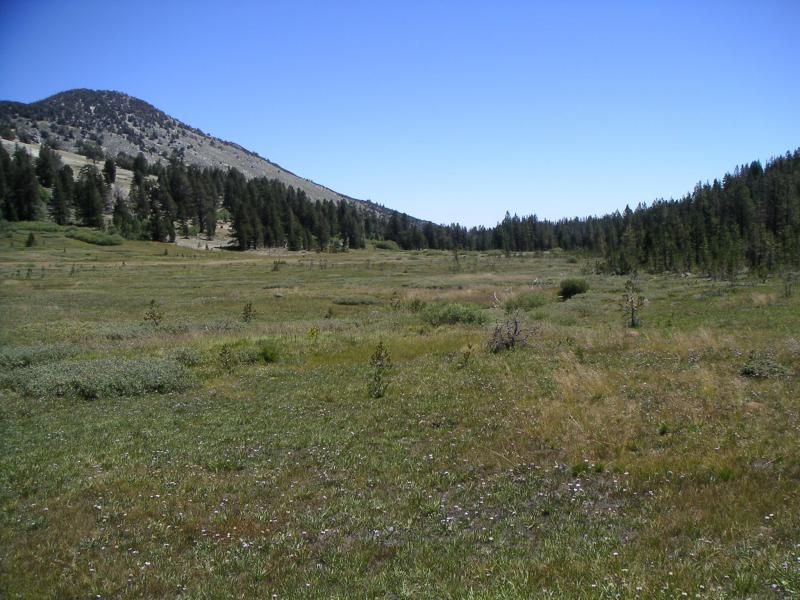
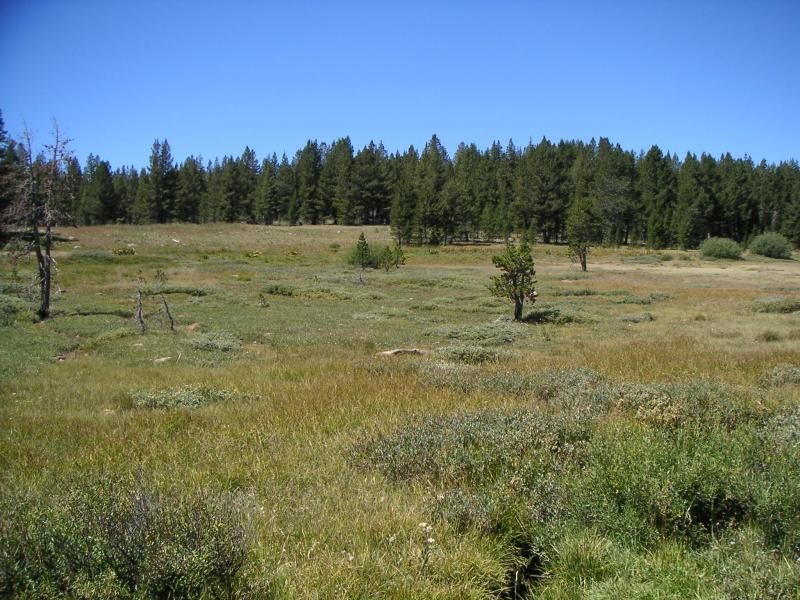
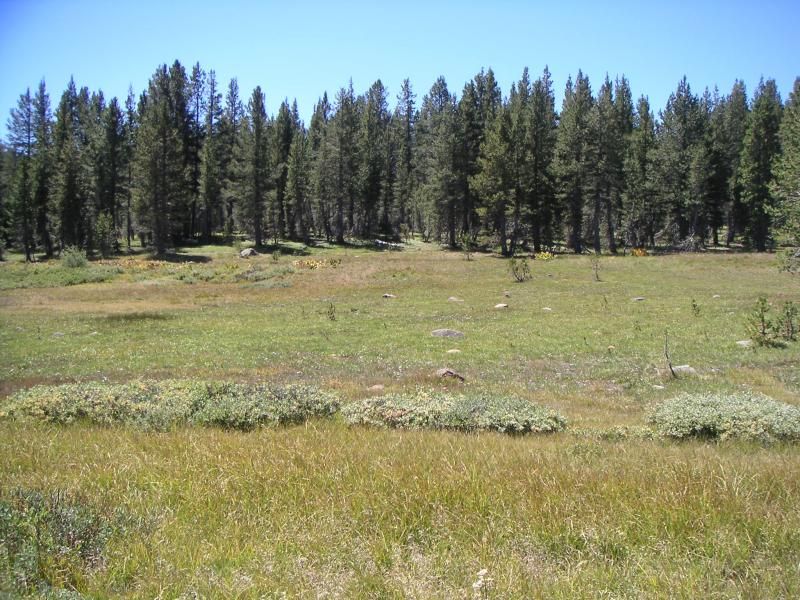
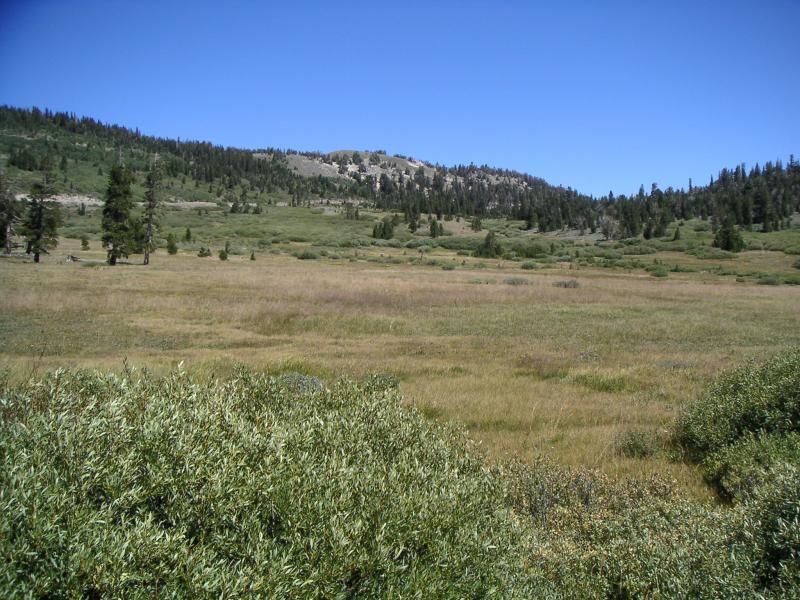
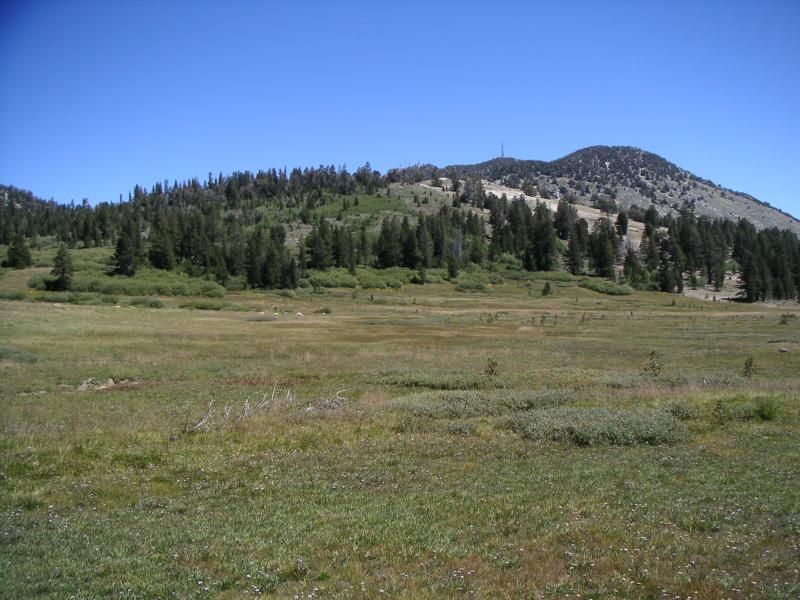
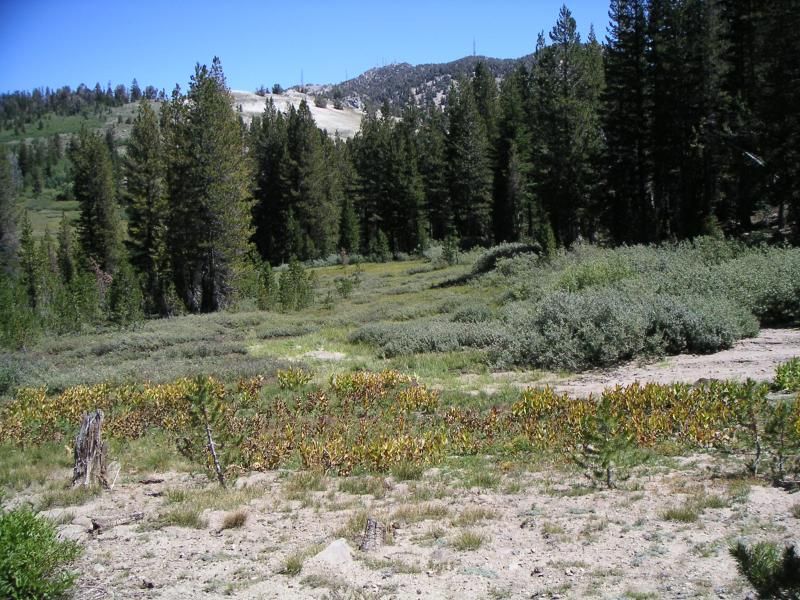
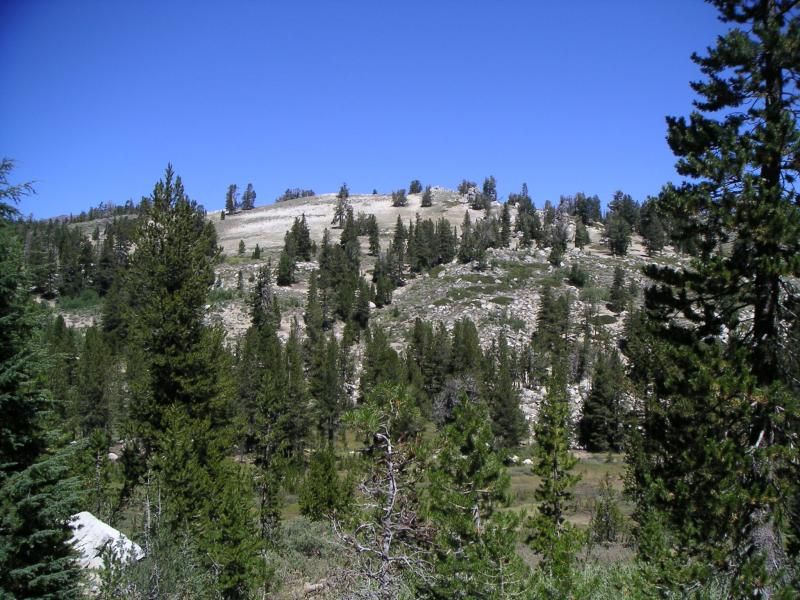
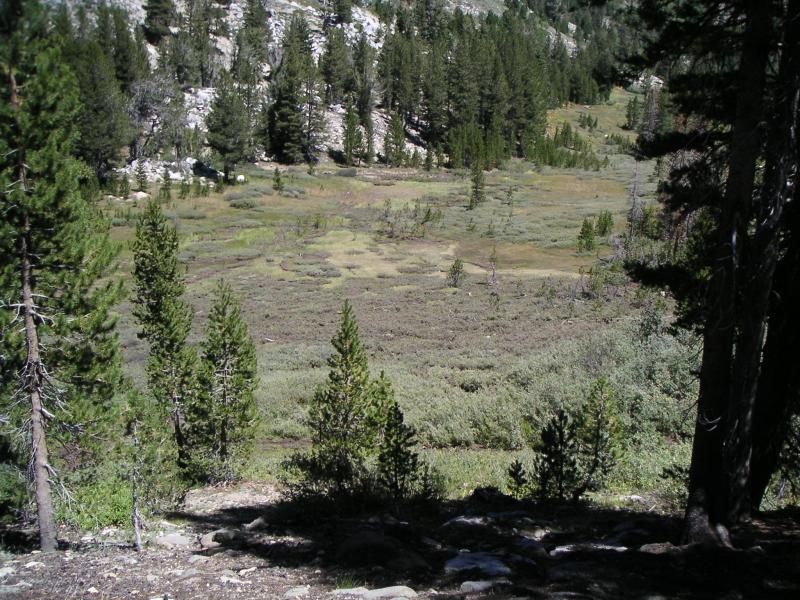
Right next to the highway over Mount Rose, connecting Lake Tahoe to Reno, just on the southwest side of the pass, is a beautiful alpine meadow. It's around 8500 feet elevation so the sky is very blue, the air is cold even on a warm summer day, and the sun burns you in minutes. You take deep breaths and walk slowly or you'll pass out from the thin air.
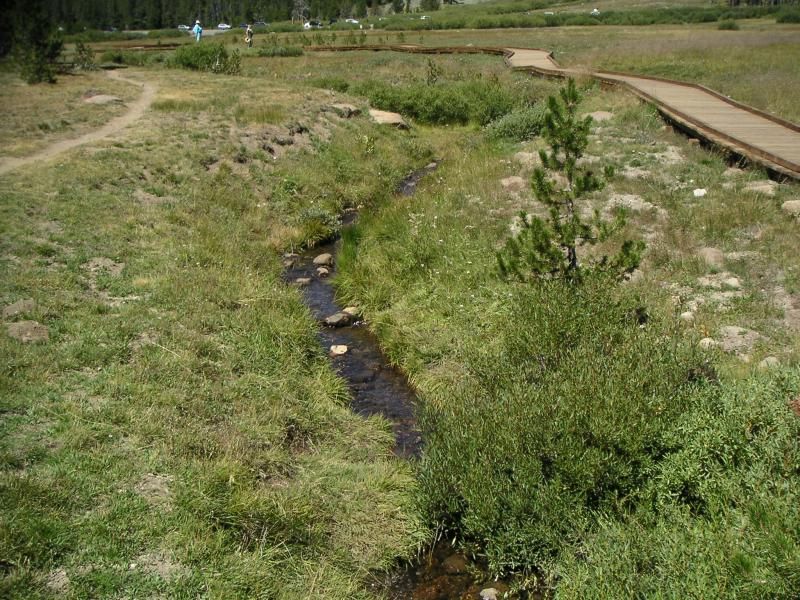
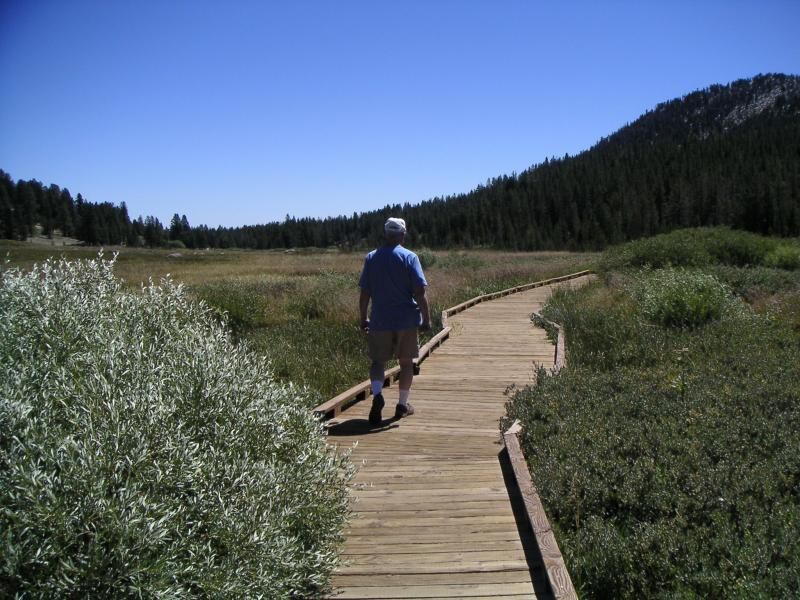
There's a boardwalk into the wetter areas. The meadow is green because a stream drains slowly across it, and they don't want people's feet eroding the ground. This sounds silly but its actually true.
I hiked there with my Dad last Sunday. Lovely warm day, but only 71'F due to the elevation.
The meadow is big and winds a couple miles down to the South.
So peaceful.
The slight scar running left to right? That's the highway.
Note the antenna on the hilltop near the center.
The yellow plants in the foreground are a type of poisonous corn lily, found through various alpine meadows. They also grow in the Upper Bear River Valley, near the intersection of Hwy 20 and Interstate 80. They're several feet tall, for scale.
Several people ate lunch on the rock at the top and center of the mountain there, across the narrow valley and above the meadow on the far side.
Meadow.
Trail on the right. See it?
It was a nice hike and while short, was scenic. A good place to take pictures and eat lunch.
California, and the West in general suffer from various disasters, and has the potential for others which happen more rarely. These disasters cost a lot of money when they happen and some are inevitable consequences of physics, some of maintenance, some are very random and completely beyond our control.
The best way to survive a local disaster is be somewhere else. Don't stand in the way of the erupting volcano, or below the dam that's breaking. So long as you CAN leave. But that's at the personal level. The govt has to deal with the disaster, though sometimes the right answer is to leave the ruin behind as a warning. Not all the ghost towns in the West are abandoned mines.
Did you know that all coastal nations in the Pacific experience Tsunamis? Any Pacific ocean quake, like the one in Thailand, is capable of generating a huge tsunami which will affect parts of the coast. Some more than others. In 1700, a major quake off the Oregon coast destroyed entire villages in Japan, which was documented by monks there, complete with woodblock prints and paintings. The wave also went 30 miles inland, knocking down entire coastal forests. In contrast, most of the Central California Coast is steep cliffs with few harbors so a tsunami is pointless and does nothing to most of it. The long slope in Crescent City north to Canada, however, Pismo and Long Beach, are both able to get some bad consequences from a tsunami. Ironically, as best as I understand the hydraulics involved, the Bay Area is largely immune to tsunami due to the narrow and deep entrance of the harbor (the Golden Gate is the gap, which the bridge is named after) and the length of the waves limits how much energy can get into the harbor. While you'd think they'd transfer energy to every shoreline and flood San Jose and go upriver and flood Sacramento... not so much. But the coasts can take a beating and there are now signs warning evacuation routes to escape incoming events, if you're lucky enough to get sufficient time to know what's coming and the alarms to sound. As we're due for a major event there, in the upper 9.6 richter scale (where the energies get really huge and the damage total) sort of like what Chile and Ecuador get, when that happens everything is gone, lots of people die, and the survivors will suffer. As it is now? There's nothing being done and the California coast is helplessly unprepared. Presumably Jefferson will do a better job.
Planning for that sort of disaster and rotating preps and assigning budget will be important. We usually do these in Veterans centers, high school gyms, any large central building where supplies can be stored and wounded treated by emergency room doctors. And its really that serious when trouble comes. Wildfires can kill from smoke inhalation too.
We need to deal with forest fires every summer and fall, and landslides and flooding follows fires. Our rainfall is seasonal, so our flooding is seasonal. We have off-times for preparation and maintenance, but LA took all the money for themselves, because they have the votes. Democracy is oppression, two wolves and a lamb deciding what to eat for lunch. This is wrong, but as long as they have the votes, we get flooding and disaster. I worry about disasters because rebuilding after them doesn't always happen. If the situation is bad enough, and the money isn't there, you end up abandoning a ruin and lose your shirt. Then you leave. And find the advantages of Mobility the other way.
Jefferson is underpopulated because most of the money that should have been spent there over the last century developing jobs was taken away by Sacramento taxes, the essential origin of their reason to divide. The Sacramento Valley towns are mostly Mexican farm workers, some of them second or third generation, others still with green cards or illegals. I think there will be no more illegals once Jefferson exists as a legal entity within California. The US Border Patrol is prevented from sweeps because amnesty threats by the President would turn them into Democratic party voters, two or three times each per election, in a blatantly illegal partisan power grab. This is war against the middle class, and the middle class is losing. Because half of them vote for the people destroying our existence. Democracy itself has failed. Without a Middle Class, America is only poor people and rich overlords who exploit and kill them. That's the reality.
Naturally, there's a couple other things we have, that happen rarely. The Southern End of the Cascade Range is in California, at the Feather River. A bit north of that end is Lassen Volcano, which last erupted in 1910. There are lovely pictures of it. The blast went northeast, tumbling house-sized blocks of rock and covering the area in ash, which drifted in the wind afterwards. Keep in mind that in The West, 1910 was still mostly unpaved roads, people on horseback, and only starting to get electricity in towns. It was still the Old West. To Geologists, Lassen is considered an active volcano and is being closely monitored for its next activity. As volcanoes tend to do their thing, their activity, for thousands of years, Lassen will go off again. Same with Mount Shasta, a fabulous stratovolcano, like Mount Fuji in Japan, with the classic cone shape and about 20 feet short of being the tallest mountain in the lower 48 states, 14,000 something feet tall. With a few eruptions it could be the tallest. Essentially, these volcanos are disasters which must be planned for. They will go off again. There will be people here, too.
There are a number of towns on the flanks of Mount Shasta, including Shasta City as its western base. Interstate 5 goes right past this town, and Mount Shasta, and in the event of eruption the road may close, depending on how it goes. It should alternate between ash, which is disruptive and annoying to potentially fatal, most of which should drift north on the breeze, to slow flows of magma down the flanks, covering the ash and providing an erosion resistant cap. The ash could shut I-5, of course, but it would likely be temporary, such as with a blizzard, which they get more often. Trucks can end up lining up in nearby towns, waiting for snow to clear, doing the run from San Diego to Vancouver, BC. The train goes through there too, running alongside the road, until winding off to deal with the slopes trains can't cross in winding turns and switchbacks before arriving in Ashland. The large sloping grassland north of Shasta is quite the vista, and the air being far from pollution is very clear, very pristine. Its one of those places worth parking your RV or trailer to enjoy it.
Just be aware there's some tinfoil hat types, and meth, and no real jobs so the town is a glorified truckstop. Of course, so is Reno. Too many western towns are like that, a place to buy gasoline, replace your snacks, and head on down the road to a real destination. This is why I obsess over geography. If there's no geographic reason, towns die once the initial settlement reason is exploited, such as a mine or timber. Here in California, there are many places which were encampments that got some stone buildings due to fires and then the mines played out and the town abandoned it for the next play. The next mine site. Ghost towns. This is what happens when your resources lack durable value.
Jefferson will be an interesting state because its two big volcanos and all the smaller ones up in the Modoc Plateau lead to desert and high lakes in the Klamath in one corner, but seacoast on its western side, barely developed due to few harbors, all needing serious work. Those harbors need dredging, and some hard decisions made about fish. When peak oil hits properly, even the diesel fuel for dragline fishing will stop being available, which means the Canadians and Japanese won't be coming here to our shores anymore. Presumably, the fisheries will get a chance to massively increase their numbers and sustainable fishing, at higher catch levels, can be made as we transition into sail powered fishing boats rather than diesel power. That won't happen overnight, and any graduate of the US Naval Academy can design a boat, as it is part of the program there, but you still have to build them. And anchor them. With the strong north winds and the Alaska current (aka Longshore Drift) responsible for the nutrients that feed the fish on our shores, you have the available power supply and food supply to have an industry. Its more work than diesel, but you can still have electric winches to run the nets. You just can't do things quite as easily. This is important. Because those jobs are careers that feed families and rebuild the economy on the coast, a place abandoned by the fussy Hollywood and silicon valley narcissists running Sacramento and deciding where the taxes go. Being abandoned by Sacramento is why Jefferson is forming. The coast is under threat from Tsunamis, and has been hit by them in recent years.
This leaves the other three regions of the state to discuss. The central valley is dependent on water, and threatened by floods, made worse by wildfires which cause erosion, which fills reservoirs which are supposed to catch floods before they hit the lowlands and flood everywhere. Same with levees holding back the rivers. Of course, water being expensive and coming at the wrong times of year doesn't fix the fact that rain shadow makes the western side of the Sacramento Valley north of woodland a largely dry area that's undeveloped. A pity, since it could become fields and orchards if only there were water available. The mountain range between the Sacramento Valley and the Pacific ranges between 3000 and 5000 feet for the most part, is craggy, formerly volcanic, heavily faulted, and gets frequent bad wildfires. They are very challenging to drive through since the roads wind and climb and descend. Its quite twisty. A bad place to break down. The few communities are often leftovers from logging camps, usually with a stable water supply since the local aquifers are generally refilled by winter rains, and there are no jobs. Logging was banned by people who don't live there. The locals subsist on growing pot and doing meth till their teeth fall out. Its pretty horrible. The one legal industry is wine. Planting and tending grapes and turning those grapes into wine keeps a small number of people employed long term, and that's great, but how many wineries can California support? At what point does the market get so saturated the values of the wine drops below the cost of production? And then what are you going to do?
Southern California has most of the tension on the San Andreas Fault, Southeast of Riverside heading for San Diego. Currently, unless the area undergoes serious deformation in the fault zone, it will crack and you should expect an 8.3 quake there, which will wreck freeways in LA and cause big landslides. The groundwaves will damage homes and break water mains and mix the water with sewer and poison everybody with cholera. Also, cost billions to fix, which will take years of trenching, pipe connections, thousands of miles of piping, and hundreds of thousands of man-hours. After the quake the only sane thing to do is leave the area. I hope they don't come here. Bunch of commies.
In the North, we ALSO have the San Andreas fault. And a bunch of other faults too. There's a big one running up the West side of the Sacramento Valley from down near Patterson all the way to Redding. There's so many faults. Pretty much every valley in the Coast Range has a fault in it. And some of the mountains too. Easterners DO NOT understand just how many faults there are. Or that most of these faults are capable of generating 7.0 quakes, enough to wreck your town, dam, road, bridge, sheer off your well and start landslides moving. These things are potent. Jefferson knows this, and people who are from here know this. We accept it. And we also know that our homes get damaged but rarely collapse, even in a big quake. Replace some windows maybe. Wood frames are good this way.
But our real problems come from fires, landslides that follow fires removing the brush the prevents erosion, and then flooding from the landslides filling in reservoirs to act as a flood control buffer. That's the trifecta of disasters in California. And fires generally follow drought, which lasts for years at a time, but also happens annually every summer. Fire season, as we call it locally, starts once the grasses dry in June, and lasts until the first hard rains come in October. Until the ground is soaked and the grasses lie down to rot from the water, we are at risk. We accept that risk, and we deal with it. That's just life in California. That's what we trade in order to ride around in convertibles and have good tans almost year round.
Its my hope that Jefferson State, and the other states that arise from the Six States division, practice sane methods for disaster preparation and mitigation. I don't expect bankruptcy or cruelty, just measured response to do a reasonable amount to keep small disasters from becoming large ones. That's all.
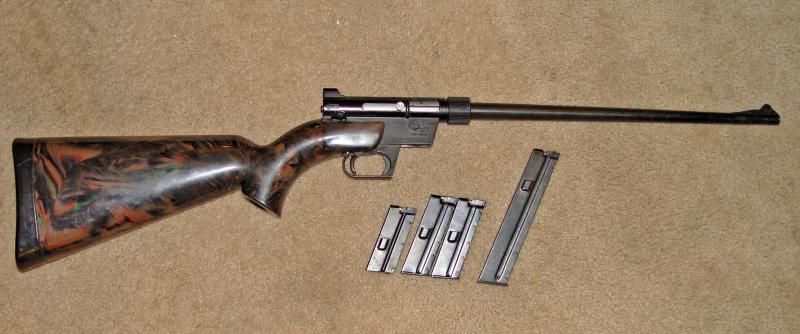
One of the baffling things about the US military is they include a survival rifle in the drop bags for all air force pilots, called the M-7, or AR-7.
And it's a .22 Long Rifle. A puny round, very inexpensive, not terribly fast, around 900-1150 fps.
Small caliber pistols are chambered for this.
If you're thinking this looks like a Nazi Luger? There's a reason.
Small boys carry .22 rifles on farms. Its a step up from a Daisy BB rifle. This is sufficient for rabbit and squirrel, but you can starve to death eating rabbit. They don't have enough fat. This is well known to survivalists. The Armalite version is actually used in the James Bond movie: From Russia With Love, and somehow effectively snipes a gypsy, and takes down a helicopter in two separate sequences. Yeah. The Bond films are hilarious.
Obviously, this should be a larger caliber rifle, even if its a slow rate of fire. Every kid taking his first American History class knows that the .30-30 Winchester has killed every single type of animal in America. Not all the kills were clean or fast, but carefully aimed? Works great. It would be utterly sensible if the survival rifle were a .30-30, even if its a break action short barrel carbine Thompson Center. As light as you can make it.
I own one of these rifles, but its heavy, comparatively. Its action is beefy to handle really big calibers like .375 Holland and Holland. If it were scaled back to much lighter rounds, it would work better at a much lower weight. If the action were engineered for a hot .30-30 spitzer (normal .30-30 bullets are 180 grain round nose and somewhat slow) it would work just fine for hunting or self defense. Should drop the total weight to around 3 and half pounds. If you also engineer it with a set offset bearings and strong lock, you can fold it in half so it is easy to extend, load, and fire. A thing like this deserves to exist.
T/C G2 Contender
Of course, if you're really good with a pistol, you can actually order a T/C Contender pistol in .30-30 or if you are a competent reloader, in 7-30 Waters or if you insist on military ammo, in 6.8 SPC. A 7-30 is a .30-30 necked down to a 7mm bullet. I would consider one of those for hiking, though .44 Magnum would probably do just as well, and with bears? Yeah, even with vicious recoil a .44 is probably a move for sanity. However, for the above survival hunting rifle? A .30-30 contender rifle would probably be best. For military persons, you can fit the rifle stock but use the shorter pistol barrel. Naturally, a reloader could use the 6.8 SPC but load it with longer and heavier 130 grain bullets, in proper weights instead of the 117 grain ones used for military purposes. Or use the 7-30 Waters with 120 grain bullets. I've fired one using 7-.223 with 140 grain bullets and the recoil was painful in the T/C Contender pistol. Hot enough that the primer was falling out, burnt. That's a sign of overpressure, dangerous levels of it. Nearly bad enough to explode the gun. Just so you know.
I totally understand the interest in long barrel .44 Magnums for wilderness carry, which would be appropriate for their needs. Some people even hunt with this, usually with a scope on the pistol. I have one of those scopes, mounted on a rifle in Scout Mount Position, which lets you aim with both eyes open. The .44 Magnum is a good caliber because you can load them for many velocities, all the way down to .45 Long Colt, and up to full Magnum (which is bright, loud and hurts). Most people shoot .44 Magnum around .44 Special (aka Bulldog) loads, which is very similar to .45 ACP, just around the speed of sound. Nobody hunts with .45 ACP, since the bullets are slow enough they sometimes bounce. Same with .40 S&W, the round most often used by police officers. That sounds absurd, but you have to understand, autopsy doctors who deal with people shot by pistols, some bullets go all the way through, doing damage, others stop in the skin itself and just fall out on the table. No penetration over half an inch. How horrible is that? That's no caliber for hunting game.
In Brazil, they have Taurus arms, which uses CNC machining to build revolvers in the .44 Magnum, and the more popular local caliber, 41 Magnum, which has better reach. Their most famous model, the Raging Bull, is setup with a very long barrel, with a compensator, and a scope. It looks ridiculous. If you can buy one of those for $800 + scope, you can afford to carry a proper rifle, which weighs close to the same and costs the same as a bolt action .308, which is a military caliber in its name as 7.62 NATO. And its got more power and longer reach.
For all of that, it baffles me. Why does the military give pilots a useless rifle like the M-7? So many better options exist. Including a paratrooper version of the standard M-4, with a short stroke bolt carrier group and folding stock.
That's simple and costs about the same and uses the standard 5.56 NATO ammunition. So what are they thinking? Hostages make good press? Pilots starving to death is okay? It baffles me.
Frugal living is often a difficult pill to swallow. Most Americans are raised to be unnaturally materialistic. How many styles of fork do you need? Isn't one pair of comfortable shoes enough? This is the result of marketing, successfully, to sell stuff we don't actually need. If you can reduce your stuff then living in an RV starts to become possible in the real world.
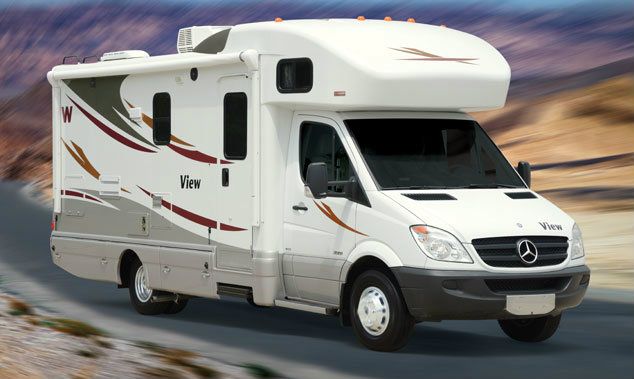
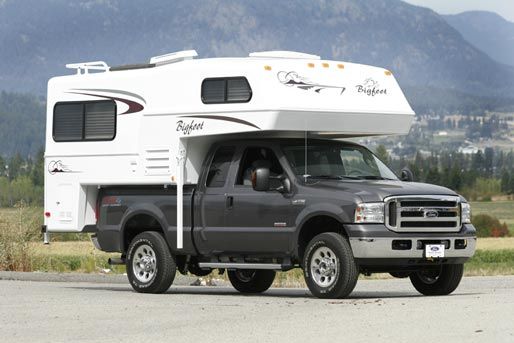
There are many types of RV. A friend of mine lives in a tiny truck camper shell, while working for minimum wage part time in a job that keeps promising to hire and pay him properly, real soon. Its been something like 4 years of that ever-extending promise. The thing is tiny, just enough room to sleep, and sit up from sleeping. It fits over the back of his work truck. My friend is a mechanic and machinist, so can keep the truck going forever, essentially. What he doesn't have is a real paying job so he can't upgrade or park it in a proper space with trailer hookups etc.
We've discussed the merits of mobile living and I'm learning a fair bit about the upsides and downsides. I get to hear all about the dirty little secrets. For instance, you can price shop your mobile home space rental, but the electric hookup and rates are unregulated so you find out you're paying several hundred a month for turning on your lights and running your fridge. That's not very nice. Most mobile home parks do this, and they get a well deserved reputation for being run by @$$holes. Sigh.
It's a shame because there's an opportunity there, to provide upscale services, higher rents, code of conduct that's properly enforced, and proper maintenance of grounds and facilities so everything works right. Imagine a mobile home park with a good restaurant that delivers? And well kept, very clean showers and laundry room and a really nice clean swimming pool. Or manicured garden and BBQ area? They had that at a nice apartment complex I stayed in, in Rocklin years ago. Back before the economy tanked. If something like that existed (they do), it would be a viable franchise.
And 6 mpg!
Like with scooters, the markup on RV's is ridiculous. The big bus-sized ones are often $300K, which is really quite a lot of money for something that's probably around $45K in materials and labor to build. They can get away with this because most people who buy them have just sold their house in retirement, tax free, and know how much money they'll need, so can spend plenty "travelling", and tend to go the budget route. For whatever reason, they figure they can live for weeks at a time in an RV cheaper than a motel and eventually get to spending entire summer and many winters in places with good weather. Places with fantastic views. Places worth spending time in.
So what about used ones? A used RV varies in price quite a bit. Buying one that's been neglected after a few trips, after the owner gets cancer and dies and his widow sells it off to get rid of it, that's the best kind to get used. They often need some outside work, some corrosion repairs, some paint, but the interiors tend to be untouched so require few real repairs and can be turned over quickly for a profit or lived in. The worst ones are the ruined engines, broken suspensions, wrecked plumbing and electrical, damaged cabinetry, and a wracked (twisted/broken) frame that's been cracked and leaking rainwater inside the walls where its been sitting for 5 years growing mildew and dryrot. That would be the worst case. An RV that's scrap, like a house with termites. Any RV for sale which advises bringing a "tow truck" to haul it away? Yeah, better be a serious mechanic. My friend is. Thinks that he might be able to buy distressed RVs, fix them and sell them. I think he's right. Done economically, they can be resold for a reasonable sum rather than the unreasonable one a new one goes for, with fewer complaints or demands.
Around here, RVs are snatched up cheap, big ones to rich people. Small ones go to the pot growers. They upgrade from the tent or lean-to or ramshackle (from where we get the word "shack") after a successful sale of a good crop to the Bay Area drug dealers. They upgrade into a camper van, sometimes a camper shell on a truck. Often these are bought as cheap as they can get. Repaired just enough to live in, and jury rigged together with cheap construction materials like scraps of siding fished out of construction site waste, caulking compound and flashing to cover the leaks. Most of what I've seen was really ugly. These are not the efforts of people who care about their work quality. Anybody who thinks nice things about The (North San Juan) Ridge is someone not to hire or do business with. Rather the same with Chicago Park. Ever since Peak Oil screwed up the affordability of commutes and shut down so many businesses in Sacramento, dropping this entire region in the sort of poverty that caused so many locals to drop into growing pot, which remains a crime, to survive. Rich people still buy RVs to snowbird or escape the summer heat for the high country, or get a different view, but the poor skeezy trailer trash and pot growers buy RVs and trailers as cheap as they can get, and stay high or drunk as long as they live, which is often surprisingly long. Not much HIV around here so the local STDs don't seem to kill like they used to.
I've already written about trailers. And those are fine, provided you can turn around. An RV can be a truck, a van, a bus with a house on the back. It is self powered. Some have the engine in the front. Some in the back. Most have a generator. I would get really tired of hearing that run when I'm trying to sleep. Most RVs have poor insulation. They don't have to, but that insulation removes living space from the interior, and part of the point of an RV is you go where the weather is nice and there's a pleasant view. Top Gear says that British people buy more caravans and RVs than any country in Europe, so must enjoy this. He also pointed out that you can buy a fun hatchback instead of a pulling vehicle and spend the difference on a really fancy holiday in a hotel. Which is absolutely true.
So why would you want an RV anyway? Well... in a situation where you've had a housing bubble, one that's resulted in an unstable economy with low wages, low job security, govt with high taxes but apparently no services to your own ethnic group, racist and sexist hiring practices for the few jobs left, and growing instability in laws and taxation meaning settling in one place is asking to get hit with life altering and ruinous bills you can't predict and prevent success? Something like reality. An RV could be your best bet to stay away from the crazy, move on, and be somewhere else.
An RV can unhook from the water, sewer, and electrical, top off the gas tank, and go somewhere better. This will seem attractive once you get stuck in life that makes you unhappy. Sometimes leaving really is the right answer. There are many places where abusive employment is the only kind, and poverty and exploitation are considered normal. There's a good reason people are leaving. Flee the trap. Your elders built it to hurt you, to enslave you. Flee. A house on wheels is a statement of freedom, just be sure to move it from time to time.
So apparently, the same sort of weather events the ignorant consider to be signs of their weather apocalypse have been going on for about 9,800 years before we learned how to burn coal. Huh. How about that.
A few nights ago, my Dad watched an episode of Midsommer Murders with a sort of meat pie that the patron referred to as a parachute, but turned out to be agreeable despite its looks. I recreated the recipe and served it last evening. It was tasty. Here is how to make it.
1 strip bacon
1 onion, diced
2 stalks celery, diced
2 carrots peeled and diced
3 potatoes, peeled and diced 1/2 inch cubes
1/2 cup peas
1 cup beef broth
1 steak, diced
1 T. Worchestershire (Wooster) Sauce
pepper to taste
Directions:
Marinade cubed beef in Wooster sauce for 1 hour. In skillet or large sauce pan Slow cook bacon until grease rendered into pan. Add onions, celery and carrot over low heat, cover 10 minutes, stir until onions clarified and starting to carmelize. Cut up bacon with kitchen shears. Shift veggies to side, add marinaded beef and cook slowly for 10 minutes, stirring to flip. Mix veggies and beef, add potatoes and beef broth, peas, fresh ground black pepper, and simmer covered with lid for 20 minutes or until potatoes are cooked.
Gravy
1 T olive oil
2 T flour
2 T broth
1/2 cup milk
In separate sauce pan, add flour to olive oil, mix, then heat gently until mix bubbles. Add 1/4 tsp cumin and pepper. Mix, simmer bubbles for about 5 minutes over low heat. Add a pat of butter then milk, lower heat. Sauce will thicken rapidly. Stir continuously to avoid lumps. Turn off heat. Salt as needed. Add broth from stew to sauce to expand and flavor brown gravy.
Note: this is actually a white sauce. This is not they way they teach it in cooking school, but this is the right way to make it in the real world.
Once stew potatoes are done, add gravy and stir. Liquid will thin sauce, coating all vegetables and meat. Remove from heat and spoon stew into oven safe serving bowls until 1 inch from rim.
Parachute
2 cups biscuit mix
1 cup water
Fill space in bowl to rim with biscuit. Preheat oven to 415'F, bake for 20 minutes, or until the biscuit covering has risen and browned slightly. Wait 15 minutes to serve as contents will be hot enough to burn your mouth. Very tasty though.
Serve with ale, porter, stout, Pale Ale, IPA, or red wine, as per your tastes. Would be good pub food. Sticks to your ribs.
I was just informed by TC McCarthy that ISIS troops have seized Mosul's dam, the largest in Iraq, on the Tigris River. This water supply is life for Iraq. Bagdad is screwed and will eventually surrender. Like California, Iraq is dry desert in the summer, and relies on dams to stop the floods from washing away fresh planted crops in spring. Iraq and California have the same rainfall timing and problems with summer heat. Like California, Iraqs rivers flood in spring when the mountain snowpack melts. California deals with this using a combination of dams and reservoirs to catch this water, and levees on the rivers to contain the flow and keep the water out of the fields, keep the floods from drowning and washing away our crops. The method we use works, barely, but sediment is caught by the dams, filling them with silt and sand so the reservoirs hold less and less water. Eventually, none at all, and the dams will just be a waterfall with a meadow. Much like our wildfire problem, there is heavy physical labor required to maintain this, and nobody is doing it. Why? Because it will benefit both political parties and our politics are too divided for that.
The problem with levees on rivers is a matter of physics. Rivers contain sediment and when the water slows down, in a bend for example, they drop their sediment where the water is slower, and take more sediment where it is faster, so they are always getting more and more curvy. Building a levee around the existing system is trying to confine a thing that continues to want to change, and is doing the work to break free. It is important to remember that levees are build out of dirt. So the river can absolutely dig that apart. Additionally, the river is always dropping sediment down the length of the river after the floodwaters slow down, so the river bottom keeps rising. This happens in natural rivers too. Eventually in a serious flood, the waters will crest the natural levees they construct, break free and flood the surrounding lands while finding a new course based on gravity. The old river bed, and the natural levees from prior spring floods that didn't break loose, are left behind, sometimes with Oxbow lakes like you find in Mississippi.
Jefferson state, which I believe will inevitably form due to decades of fiscal abuse by Sacramento, the legal Puppet of LA and San Francisco voters who control California, contains the two largest reservoirs in California. It contains the Shasta and Oroville Dams, and thus the irrigation supplies for the Sacramento Valley which runs from Red Bluff in the north to the San Joaquin Delta and the San Francisco Bay. The Valley's southern end merges in the Delta, most of which is full of levies and much of it technically below sea level and threatened by salt infiltration during high tides if a levee breaks, which it might. Highway 160 follows the Sacramento River from Sacramento down to Isleton, which is the eastern extent of the Bay's salt water and entrance to the Port of Sacramento Channel. Yes, there is a port in Sacramento. Yes, ships go there to on and offload things, including bags of rice bound for China and Japan that were grown in Marysville by the Sutter Buttes. Its a major source of income for California. Worth a couple billion dollars a year. When Easterners say "California shouldn't grow rice" they don't know what they're talking about. It earns more money than High Tech does. At this point, there's little high tech in California. Just buildings and managers calling China and India and fussing over the stock values of their rebranded products built by wage slaves in Shanghai. Rice is grown here. Rice is profit. Not shipping rice is a cause of major panic in China and Japan.
So Jefferson controlling the water supply that allows rice to be grown? That's an international issue. A big one. Whether Yuba and Sutter Counties join Jefferson, and get a fair price for water so they can keep growing the Rice that's propping up Japan and helping our balance of trade with that nation, and keep in mind that California could be terracing very small rice fields in the interior of the North Coast due to the rains and water supply available up there. We could easily quadruple the rice growing land, but that only works if it can be sold, and in agriculture you only plant what you can sell or you go out of business pretty quick. Small scale farm equipment, like tractors and combines, are crucial. And those can be rented and leased, though farmers like to buy them if they can, to control costs better. As bad as the drought is, farmers aren't sitting on their behinds. There's a lot of soil prep work being done, since we don't get the sorts of winds to cause dust storms, and no thunderstorms worth mentioning down in the farmlands.
Jefferson supporters plan to charge more for the water that they release downstream, for pumping to the Bay Area and LA by the pumps near Tracy that feed the California Aqueduct system. Jefferson has a vested interest in returning the Salmon, which suggests they'd only release water to aid the fish, and might get highly annoyed if the Bastards running the pumps turn them on and chew up the salmon fry like they've been doing since 1978. They committed economic warfare against the North Coast fisheries so they could water driveways in Los Angeles, something we have pictures and video of them doing. Not okay. Entire towns died and fishermen lost their boats, their families, their lives when the salmon were churned into sludge by the pumps near Tracy. The smelt are an irrelevance compared to the value of salmon in the Pacific North Coast of California, what will be Jefferson. The lives impacted by LA's greed destroyed the economy of the entire region, plunging hard working towns into a still imposed permanent poverty. Some of them shifted into timber operations, harvesting redwoods and oaks for decks and furniture, for sale down in LA and Berkeley. The Berkeley hypocrites responded by spiking trees and killing timber and sawmill workers who'd just lost their boats when the salmon were wiped out by those benefiting from their efforts.
Berkeley has a SPECIAL place in my heart because of this. Earth First said spiking trees isn't violence despite the spikes, made of ceramic and undetectable, causes a 12 foot diameter saw blade to explode on contact and kill the mill operator, a guy getting minimum wage and caring for a family of four. But killing him is okay because he's white so he deserves it because... Trees? And this happened multiple times. I knew surviving family when I was in school. The few hippies that were "disappeared" over this were victims of a quiet civil war in the 1990's until the Old Growth Redwood logging ban ended the logging and dropped everyone up there into the poverty that lingers today. The hippies went back to Berkeley, cheered by the success of their violent attacks on the rural poor, enjoyed their redwood decks and ate imported Atlantic salmon. My generation HATES hypocrites. This is something the folks in Jefferson also know.
And its not like the money will go to waste, either. The North Coast needs reliable highways. Highway 101 washes out in normal rainfall. Building a stable road in those bad areas would help the locals retain access to crucial things like hospitals and food supply. Dredging the harbors to allow freighters to onload and offload cargo and run the coastal ferry system again? Important. Restoring the Pacific Coast Railway to operation again? Also key. As a new state, they can ignore prior logging rules imposed by UC Berkeley hypocrites and manage their timber as needed, including the planting and stabilization efforts that Berkeley wouldn't fund because it was always about hatred and violence, never about the trees. Didn't know they ignored replanting? Yep. After the clearcuts, the Berkeley hippies didn't plant new trees. If it were really about trees, they'd have done that, and made sure the saplings actually rooted properly. It was never about the trees. That was the excuse for the violence. Redwood Summer 1990 was really about murder. I am glad that Judi Barri blew herself up. She was evil.
The hard part of the division is the enduring rage. Generations of Californians hurt by bullies in the built up urban areas, the callous junkies and neurotics and wasters in Berkeley, San Francisco, Hollywood and LA. These are the voters who had the numbers to bully the rural areas and abuse everyone else into poverty. Forgiving them and playing nice after we become multiple states is unthinkable because the money is needed for basic infrastructure that was neglected since the 1980's. LA wanted smoother freeways. We wanted ones that weren't closed entirely be landslides every time it rained. Funding those long overdue projects means selling the only resource worth anything: water supply. Jefferson will BLEED Silicon Valley for money, jacking up rates until the dregs of the Middle Class still there start fleeing the East Bay and South Bay settlements. It's not like their jobs really pay that well. The Federal govt will doubtless subsidize a few of the poor for public relations photo ops, but realistically the price of water is going to destroy the Bay Area. The cost of water equaling your monthly rent or mortgage payment will depopulate it and leave it as crime ridden and abandoned as Detroit is now. That's my prediction.
Dividing California will unchain the dogs of long held resentments, and I worry about actual violence over control of the water. Charging more than is easy to pay, which is anything more than they pay now, to San Francisco is likely to call out the national guard, sending armed men across state lines to seize control of the powerhouses of Shasta and Oroville dams. It sounds crazy, but seizing Oroville dam means they can release water anytime they want, without paying. And arming the dam powerhouse and building fortifications to shoot militia attempting to retake the primary money supply for their state would certainly escalate into deaths and actual war, right up to blowing up the dam and wrecking the reservoir, to flood the farmlands and destroy everything downstream. We already know the Bay Area commits violence against the rural poor. They've done it again and again. Worse, the floods would create water for mosquitoes, so biowarfare associated with malaria and meningitis is exactly their style. If there's nobody in Jefferson alive to complain, so much the better. And yes, I do think the Bay Area would commit mass murder. They already did. They care most about winning. Its the essential poison of ambition which drives the place.
Sure, that sounds absurd, but keep in mind, Berkeley killed hundreds of people over trees, if you include the jobs and families destroyed by the logging ban. Entire towns died out over the loss of the salmon, and LA used the water to wash their cars and clean the dust off their driveways. The Aqueduct was sold to California voters as a way to make the San Joaquin bloom with new crops and money, but the west side of the San Joaquin gained some orchards for Vitamin C, but the rest of I-5, where the aqueduct goes, is mostly desert. The promised development just didn't happen. Much of the land planned for crops turns out to have too much calcium in the soil and it turns into a kind of natural concrete a few feet down that seals up the fields, preventing drainage and crops die, their roots choked to death by the stagnant water. Roots need air. They have to have drainage. Voters didn't know this. And you can't really fix Caliche (the concrete) without physically removing both the calcium soil AND breaking up the concrete, which is so expensive its ridiculous. No crops would pay for that. Even rice fields have to dry out for harvest. The planned Cotton and Wheat just can't work there. So the fields are empty, turning back into sand, and the area grows more tumbleweeds than anything else.
The water of the California Aqueduct is mostly just rolling South to LA, using the hydroelectric power generated by the dams down the Feather River, and carried by high tension towers down the center of the valley, ignoring cities, to the various pump stations, except the two most important ones: Tracy and Grapevine. Yes, the aqueduct is a feat of engineering, BUT the consequences impoverished the North Coast and there has been nothing done to reverse the poverty. LA doesn't care about a bunch of poor people far away, unless they have cute outfits and ancient religions they can pretend to care about. They love Tibet, but ignore poor Christians in their own state. See why revenge is necessary?
So yeah, division, then water wars. Complete with special forces attacks on dams, power tower sabotage, aircraft bombing water infrastructure. You name it. This will happen. Its one of those things you can't stop. It's a long time coming and the scales will balance in blood and poverty. If you live in LA or San Francisco area, think hard about what price of water you can afford and when it is time to move out. Both places are on long supply chains and sit upon a lot of abuse. Retaliation will be charged against YOU. Don't be there when the aqueduct shuts down. There's only about 45 days of water supply to those cities stored locally. There will be a serious rush for the Uhauls. You might have to discard lots of your precious stuff when you flee in thirst.